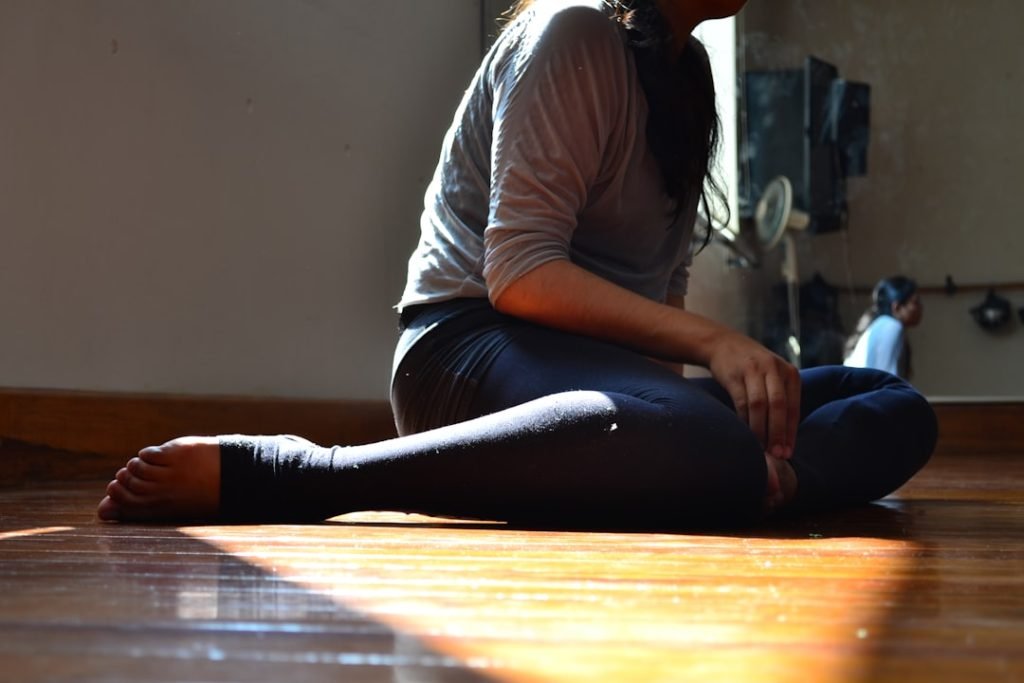
The word “somatic” sounds clinical until you understand what it means: from the body. Somatic exercises are movement practices that work by directing attention into the body — into sensation, tension, and physical patterns — rather than through it on the way to a fitness outcome.
That distinction matters more than it sounds. Most exercise is goal-directed: build strength, improve cardiovascular fitness, burn calories. Somatic movement has a different aim — to release the tension, bracing, and holding patterns that accumulate in the body over years of stress, overwork, and chronic activation.
If you’ve spent years pushing through — carrying stress in your shoulders, clenching your jaw in meetings, waking up already tired — somatic practices address something that a harder workout often doesn’t.
1. Why the Body Stores Stress (and Why This Matters)
The nervous system’s stress response — fight, flight, or freeze — is designed to be temporary. A perceived threat triggers a cascade of physiological changes: cortisol rises, muscles tense, breathing shortens, heart rate climbs. When the threat resolves, the system returns to baseline.
But under chronic stress, this return doesn’t happen fully. The body stays partially activated — not in acute crisis, but not in genuine rest either. Muscles that activated to respond to threat remain slightly contracted. Breathing patterns shift and don’t shift back. Posture adapts to a perpetual state of readiness.
Peter Levine, the developer of Somatic Experiencing and author of Waking the Tiger, observed that animals in the wild discharge stress through physical movement — trembling, shaking, running — after a threat passes. Humans, socialized to suppress these responses, often don’t. The result is what Levine called “incomplete” stress responses — physiological activation that gets held in the body rather than released.
This isn’t abstract theory. You can feel it: the chronic tightness between the shoulder blades that no massage quite resolves, the belly that won’t fully relax, the baseline tension that feels like your body’s default state.
Somatic exercises don’t teach you to ignore what your body is holding. They give you a way to work with it.
2. What Somatic Exercises Actually Involve
Somatic movement exists on a spectrum. At one end are clinical practices like Somatic Experiencing (typically done with a trained therapist for trauma). At the other are accessible, self-directed exercises anyone can do — and it’s these that are increasingly backed by research and accessible to most adults.
Common somatic practices include:
- Body scanning — systematically bringing attention through the body, noticing areas of tension or sensation without trying to change them immediately
- Grounding exercises — standing or sitting with deliberate attention to contact with the ground; feeling weight, pressure, and physical support
- Slow, exploratory movement — gentle rolling, stretching, or rocking that follows sensation rather than a choreographed sequence
- Pandiculation — the voluntary contraction and slow release of a muscle group; distinct from stretching because it involves active engagement before release (think of a full-body morning stretch, but deliberate)
- Tension and Trauma Release Exercises (TRE) — a specific protocol developed by David Berceli that uses gentle shaking and vibration to discharge held tension
What these practices share: they’re slow, they require internal attention, and they work with sensation rather than suppressing it. They’re the opposite of pushing through.
3. The Research Basis
Somatic practices have historically been understudy compared to pharmacological and cognitive therapies — not because they’re ineffective, but because they’re harder to standardize for clinical trials. That’s been changing.
Anxiety and stress. A 2021 review in the Journal of Traumatic Stress found body-based interventions — including somatic experiencing and body-oriented therapies — produced significant reductions in PTSD and anxiety symptoms. A 2023 study in Frontiers in Psychology found somatic movement practices improved perceived stress and emotional regulation in adults without clinical diagnoses.
Chronic pain. Interoception research — the study of internal body awareness — links higher interoceptive sensitivity to better pain management. Somatic practices directly train interoception. A 2022 systematic review found body-awareness interventions reduced chronic pain intensity and improved quality of life.
Nervous system regulation. This connects directly to how the vagus nerve and parasympathetic nervous system work. If you’ve read our piece on the vagus nerve, you’ll recognize the mechanism: somatic exercises tend to activate the parasympathetic response, which is exactly what chronically stressed nervous systems need more of. The piece on what nervous system regulation actually means gives more context on the underlying physiology.
Sleep. Several studies on yoga nidra and body-scan practices — both somatic in nature — show improvements in sleep quality, particularly for people with stress-related insomnia.
4. How Somatic Exercises Differ from Yoga, Pilates, and Stretching
The overlap is real — good yoga and Pilates instruction incorporates somatic awareness — but there are meaningful differences.
Stretching lengthens muscle tissue; somatic exercises primarily work with the nervous system’s patterns of tension, not just the tissue itself. You can stretch a chronically tense muscle and have it return to the same state because the signal to hold tension is neurological, not mechanical.
Yoga combines breathwork, posture, and mindfulness in ways that can be profoundly somatic — but many yoga classes are still externally directed (following the teacher’s sequence, reaching certain poses), whereas somatic practice is internally directed throughout.
Pilates builds core strength and postural awareness — useful for many of the same people interested in somatic work — but the goal is muscular control and stability, not tension release.
These aren’t competing. People who practice somatic exercises often find they enhance the benefit they get from other movement too.
5. A Simple Somatic Exercise to Try Now
This takes five minutes and requires nothing but a chair or a floor.
- Sit or lie down comfortably. Close your eyes if that feels safe, or soften your gaze downward.
- Take three slow breaths. No particular technique — just let them be slower than your usual pace. Notice where in your body the breath lands.
- Scan slowly from your feet upward. Not to fix anything — just to notice. Is there warmth? Tightness? Numbness? Pulsing? Avoid labeling sensations as good or bad.
- Find an area of tension. When you locate it, breathe toward it — imagine the breath moving into that space. Then on the next exhale, allow the area to soften slightly. Don’t force relaxation; just give it permission.
- Notice any impulse to move. If a hand wants to shift, a shoulder wants to drop, a neck wants to turn — follow it, slowly. These small movements are the nervous system completing responses it held incomplete.
- Return to normal breathing. Open your eyes. Sit for a moment before you stand.
That’s the core of somatic work: attention, permission, slow follow-through. You can extend it to 20 minutes or keep it to 5. The depth of the practice scales with time, but even a short session returns something — a slightly lower baseline of activation, a small degree of release.
6. Who Benefits Most
Somatic exercises are relevant for almost anyone managing ongoing stress — but they’re particularly useful for:
- People whose stress manifests physically — chronic muscle tension, headaches, digestive issues, fatigue
- Those who find purely cognitive approaches (journaling, talk therapy) helpful but incomplete
- People who describe themselves as “always on” — unable to genuinely switch off even in downtime
- Adults over 40 navigating the physical effects of years of high-demand work
- Anyone who has tried relaxation practices but found them hard to access — somatic work often provides a body-based entry point that’s easier than purely mental approaches
They’re not a replacement for medical care. If you’re managing a diagnosed condition, talk to your healthcare provider about how somatic practices might complement your treatment.
Common Questions
Do somatic exercises work for anxiety?
Evidence suggests yes — particularly for the physical component of anxiety (racing heart, shallow breathing, muscle tension). They don’t address the cognitive content of anxiety directly, which is why many practitioners combine somatic work with cognitive approaches for the fullest effect.
Is somatic work the same as trauma therapy?
Clinical somatic therapies (Somatic Experiencing, Sensorimotor Psychotherapy) are trauma-specific and require a trained practitioner. The self-directed somatic exercises in this piece are not trauma therapy — they’re movement and awareness practices for everyday stress regulation. If you’re navigating trauma, a qualified somatic therapist is the appropriate starting point.
How often do somatic exercises need to be done to notice a difference?
Even one to two sessions per week produces benefit in most studies. Daily practice of even five minutes produces more consistent results. Like most movement practices, regularity matters more than duration.
Can somatic exercises feel uncomfortable?
Sometimes, especially when first bringing attention to areas of chronic tension. A mild sense of intensity or release is normal. If you experience sharp pain, emotional overwhelm, or distress, stop and, if relevant, speak with a practitioner. Somatic work at a self-directed level should feel like a safe exploration, not a confrontation.
Take This Further
Lighthouse Quill’s upcoming Somatic Exercises for Nervous System Regulation goes significantly deeper — the full evidence base, a structured sequence of exercises organized by type and duration, and guidance for building a practice that fits your actual week.
The first chapter is free.
Your body has been holding something for a while. You don’t need to force it to let go. You just need to give it the conditions — and the permission.
