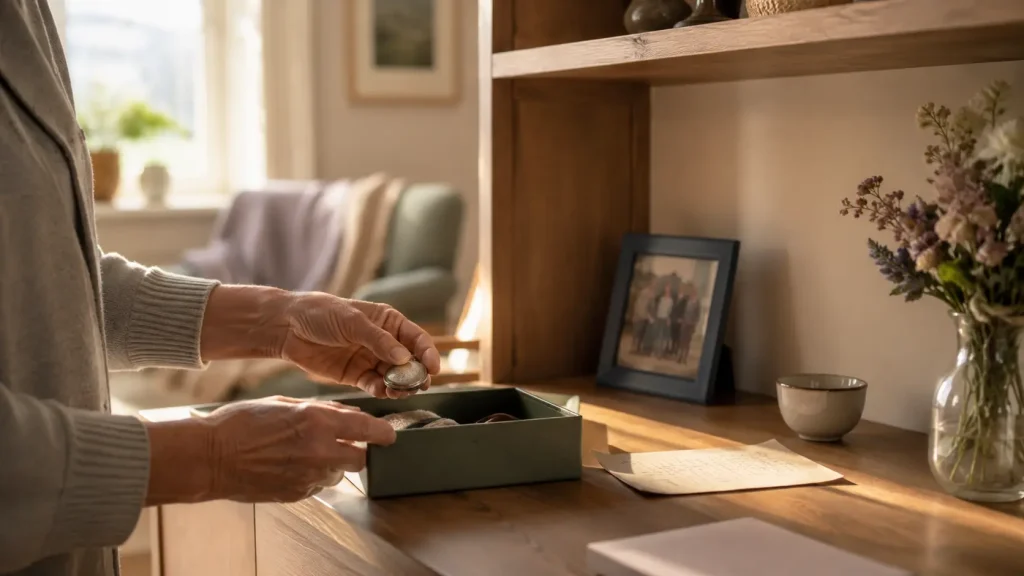
There’s a particular afternoon that arrives in most lives. The house is quiet in a way it didn’t used to be. Maybe the last child has moved out, or a retirement date is circled on the calendar, and you find yourself standing in a room you’ve stood in a thousand times , seeing it properly for the first time in years.
And a thought surfaces, quietly: these things aren’t holding my life anymore. They’re holding my past.
For most of us, that thought comes wrapped in something complicated. Nostalgia. A flicker of guilt. A wave of overwhelm at the sheer volume of it all. And underneath, a fear that rarely gets said out loud , that letting go of the things means letting go of the people, the years, and the versions of ourselves they stand for.
It doesn’t. That fear is doing you a quiet disservice, and the rest of this is about why , and what to do instead, entirely at your own pace.
The Swedish Idea That Reframes the Whole Thing
The Swedish practice of döstädning , literally “death cleaning” , sounds severe translated into English. In Sweden it’s understood as something far warmer: the gradual act of putting your home in order so that your life, and one day your legacy, is a gift to the people you love rather than a burden left behind.
The word that matters in that sentence is gradual. This isn’t a weekend purge or a dumpster in the driveway. It’s a slow, considered editing of a life , and editing is a creative act, not a destructive one.
You are not discarding your memories. You are choosing their keepers.
That distinction changes everything. When you pass your mother’s tea set to the niece who always admired it, the memory doesn’t shrink , it travels, and it gains a new chapter. When you photograph the children’s artwork before recycling the originals, you keep the love and release the weight. Done with intention, letting go is curation. It is the opposite of erasure.
Why It Feels Like Loss (and Why That Feeling Is Misreading the Situation)
There’s a real reason this is hard, and it isn’t weakness. Psychologists have a name for part of it: the endowment effect , the well-documented tendency to value something more simply because it’s ours. We over-weight what we already own, which is exactly why a chipped mug we’d never buy today can feel impossible to part with.
Layer onto that the way memory actually works. The keepsake doesn’t store the memory; you do. The object is a prompt, not a hard drive. This is genuinely good news, because it means the memory isn’t at risk when the object leaves. You can hold the feeling and release the thing , they were never the same item.
The reframe, in one line: you’re not losing anything that mattered. You’re lifting a weight off the things that matter most, so they can finally be seen.
Start With the Easiest Room , Never the Hardest
The most common mistake is to begin with the photographs, the letters, the sentimental heart of the home. It’s the fastest route to stalling, because every single object demands a decision you’re not yet practiced at making.
So begin where the stakes are low. The garage. The linen closet. The kitchen drawer that hasn’t fully closed since 2014. Places where decisions are practical, momentum builds quickly, and every cleared shelf teaches your nervous system one quiet, repeated lesson: this is safe, and lighter feels good.
A gentle order to work in:
- Utility spaces first , garage, shed, hall closet, the “junk” drawer.
- Then duplicates and obvious excess , the fourth colander, the cables to devices you no longer own.
- Then clothes and linens , easier than they look once you’re warmed up.
- Books, paperwork, and hobby supplies next.
- Sentimental items last , by which point deciding has become a skill, not an ordeal.
By the time you reach the truly meaningful things, you’ll bring something you didn’t have at the start: the practiced ability to decide, and the felt experience that a clear surface is a relief rather than a betrayal.
Three Questions That Make the Decision Easier
When you do reach the harder objects, you don’t need a rule. You need a few good questions to hand the choice back to yourself:
- If I photographed this, would the photo be enough? Often, yes , and a labeled photo album becomes its own kind of keepsake.
- Is there someone who would genuinely love this now, not “one day”? An object in use is honored far more than one in a box.
- Am I keeping this for the memory, or out of guilt? Guilt is not a reason to keep anything. You’re allowed to let it go and keep the love.
Notice that none of these is an order. There’s no correct answer waiting to catch you out. The point is simply to make the choice yours, made on purpose, rather than a default you drifted into.
What Remains Is What Matters
Here’s the part readers tell us they didn’t see coming. The best of this process isn’t the relief, real as that is. It’s the rediscovery.
When a home stops being an archive of everything, the things you’ve chosen to keep begin to stand out. Your grandmother’s clock. The painting you actually love. The handful of objects that genuinely tell your story. They stop competing with the clutter and start to shine. The home becomes , perhaps for the first time in decades , intentionally, unmistakably yours.
And that’s what the next chapter deserves. Not an empty house. A clear one.
What to Do With the “Maybe” Pile
Somewhere in every honest sort there’s a pile that defeats the three questions above , things you can’t keep with a clear heart and can’t release without a pang. Don’t force those. Forcing is exactly what makes people give up on the whole endeavor.
Instead, give them a single labeled box and a date a few months out, and put it somewhere you won’t trip over it. When the date comes, open the box with fresh eyes , and you’ll find most of it has quietly lost its grip on you. The decision you couldn’t make in spring is often easy by fall. That isn’t procrastination; it’s giving a hard choice the time it genuinely needs to settle.
Keeping a “maybe” box isn’t a failure of nerve. It’s a way of staying kind to yourself while the harder feelings do their slow work in the background.
The Quiet Joy of Giving Things Away Now
Here’s a part of döstädning that catches people off guard: the best of it can happen while you’re very much alive and well , and it can be a real pleasure rather than a chore.
When you hand your daughter the necklace now, you get to see her wear it. When you pass the woodworking tools to the young neighbor who’s just getting started, you get the story of where they went and who they’re helping. Giving things away while you’re here turns letting go from a single heavy event into a series of small, warm exchanges , and it spares the people you love the harder version of this task later.
A few things make it easier on everyone:
- Offer specific objects to specific people, rather than a vague “take whatever you want.” It’s far easier to say yes to one named thing.
- Let a no be a no , without guilt on either side. Not everyone wants the china, and that’s completely allowed.
- Keep a short written note of who you’d like to receive what. It removes guesswork later and quietly prevents the disputes that objects can cause.
Common Questions
Isn’t “death cleaning” a morbid thing to do?
It tends to feel like the opposite once you start. Far from being about death, it’s about removing a quiet source of stress from daily life and sparing the people you love a painful task later. Most people describe it as lightening, not lowering.
How do I let go of things without upsetting my family?
Ask them. A simple conversation , “is there anything here you’d love to have?” , often reveals that the items you feel guilty about aren’t the ones they care about at all. You get to offer first, then decide the rest with a clear conscience.
Where do I actually start?
Somewhere unsentimental and small , one drawer, one shelf, one cabinet. Finish it completely, notice how it feels, and let that feeling carry you to the next. Momentum, not heroics.
A gentle next step
If this is the threshold you’re standing on, our book Swedish Death Cleaning for Women Over 50 walks you through the whole process the same way , calmly, practically, and at your pace. You can read the first chapter free: send me the free chapter. There’s no rush, and nothing to prove. The agency, as ever, is entirely yours.
When you’re ready for the next piece , clearing a home that belonged to someone you loved , The Inherited House: A Gentle Guide is here when you need it.
