The pile on the spare bed has been there for eight months. You walk past it, tell yourself you’ll deal with it on the weekend, and close the door. Then Monday comes, and the door stays closed again.
This isn’t a discipline problem. It’s a start problem. When the whole house feels like it needs attention, the brain freezes, and nothing moves. The research on decision fatigue backs this up: the more choices we face at once, the less capable we become of making any of them well.
So the fix isn’t trying harder. It’s making the first step so small it’s almost impossible to avoid. Here’s how.
1. Stop Thinking About the Whole House
The single biggest obstacle to starting isn’t motivation, it’s scope. The moment you frame the task as “decluttering the house,” you’ve already made it too large to begin.
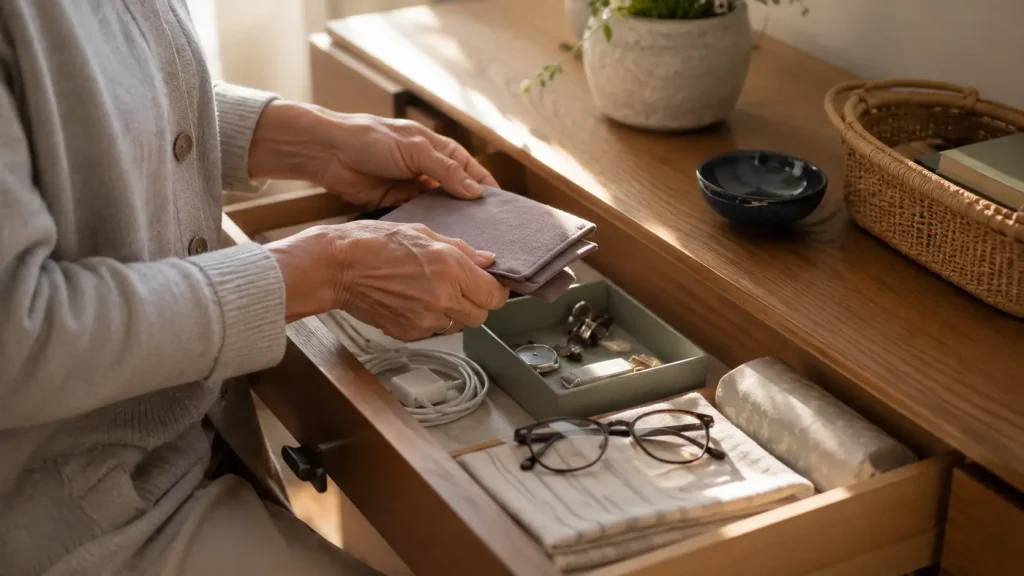
Start with one surface. Not a room. Not a category. One surface, a kitchen counter, a bedside table, the top of a dresser. Give yourself 20 minutes and nothing else.
This isn’t a productivity trick. It’s how the nervous system actually works. A task your brain registers as manageable gets started. A task it registers as overwhelming gets avoided. You’re not being lazy, you’re being human.
The goal isn’t a perfect home. It’s a home that works for the life you’re living right now.
2. The Room-by-Room Sequence That Creates Momentum
Once you’ve proven to yourself that you can start, sequence matters. Not because there’s a “right” order, there isn’t, but because some rooms generate momentum faster than others.
Start with a low-stakes room
A bathroom, a laundry room, a hallway closet. These spaces hold less emotional weight than, say, a bedroom or a study filled with inherited items. They clear faster, and a fast win matters when you’re just building the habit of going through things.
Save sentimental spaces for later
The box of your mother’s letters. The children’s artwork from 1998. These deserve your full attention, and your full attention is available only after you’ve warmed up on easier decisions. Working through emotionally charged items first is one of the most common reasons people give up. Leave them until you’ve built some momentum.
If you’re navigating a home with layers of history, yours, a partner’s, perhaps a parent’s, this guide to clearing an inherited home may be useful too.
3. The Three-Pile Rule (Simplified)
Elaborate sorting systems create more decisions, not fewer. Keep it to three:
- Keep. It earns its place in your home and your life right now.
- Let go. Donate, sell, or pass along, whatever fits your situation.
- Decide later. One box. One deadline (two weeks maximum). If you haven’t thought about it by then, let it go.
The “decide later” pile is not permission to procrastinate indefinitely. It’s a pressure valve that keeps the rest of the process moving.
4. What to Ask Instead of “Should I Keep This?”
“Should I keep this?” is the wrong question, it leads straight to guilt and circular thinking. These work better:
- Does this belong in the life I’m living now, or the life I used to live?
- If I were moving house next month, would I pay to bring this with me?
- Who would genuinely enjoy this more than it’s being enjoyed here?
- Am I keeping this out of love, or out of obligation?
None of these questions have wrong answers. They’re just more honest than “should.”
For a deeper look at the emotional side of these decisions, this piece on why letting go doesn’t have to feel like loss addresses what often happens once the physical work begins.
5. The Swedish Death Cleaning Approach: A Practical Framework
Swedish death cleaning, döstädning, isn’t morbid. It’s practical. The idea, rooted in Scandinavian tradition and popularized by writer Margareta Magnusson, is simple: go through your belongings while you still can, so the people you love don’t have to do it under grief.
What makes this framework useful isn’t the mortality angle, it’s the clarity. When you ask “who would want this after I’m gone?”, something shifts. Items that felt impossible to decide on suddenly become obvious. Things you’re keeping out of vague obligation reveal themselves. And the things you genuinely love become clearer too.
It’s a question that returns the agency to you, and removes the guilt from the equation entirely.
Common Questions
How long does decluttering a whole house actually take?
There’s no fixed answer, it depends on how much you have, how often you work on it, and how emotionally complex the items are. Most people find a room-by-room approach over several weeks or months more sustainable than a single weekend overhaul. Steady progress over time tends to stick.
What if I clear things out and regret it?
Regret is less common than most people expect. Research on the psychology of letting go suggests we consistently overestimate how much we’ll miss objects, and underestimate how much lighter we’ll feel without them. If you’re genuinely uncertain about something, put it in the “decide later” box.
Is there a “right” way to do Swedish death cleaning?
No. The approach is a mindset, not a method. You get to decide what it looks like in your home, at your pace, in whatever order makes sense for your life.
One More Thing Before You Close This Tab
The first chapter of Swedish Death Cleaning for Women Over 50 covers exactly this, where to begin, what to expect emotionally, and how to build a pace that works for a real, over-scheduled life. It’s free, and it’s waiting for you.
The door to that spare room can stay closed one more night. But when you’re ready, start with the surface nearest to you. That’s enough.
